Although the famous Carrington Event of 1859 is often described as the first major space weather event to affect technology, earlier incidents did occur. Historical records show that telegraph systems were disrupted by geomagnetic storms as early as the late 1840s. An anonymous 1871 article in the journal Nature even suggested such an impact happened in 1841, when a railway telegraph system in southern England was said to have malfunctioned and delayed a train at Exeter. However, Professor Jim Wild from Lancaster University and colleagues found that this account cannot be correct because the railway line mentioned did not exist at that time.
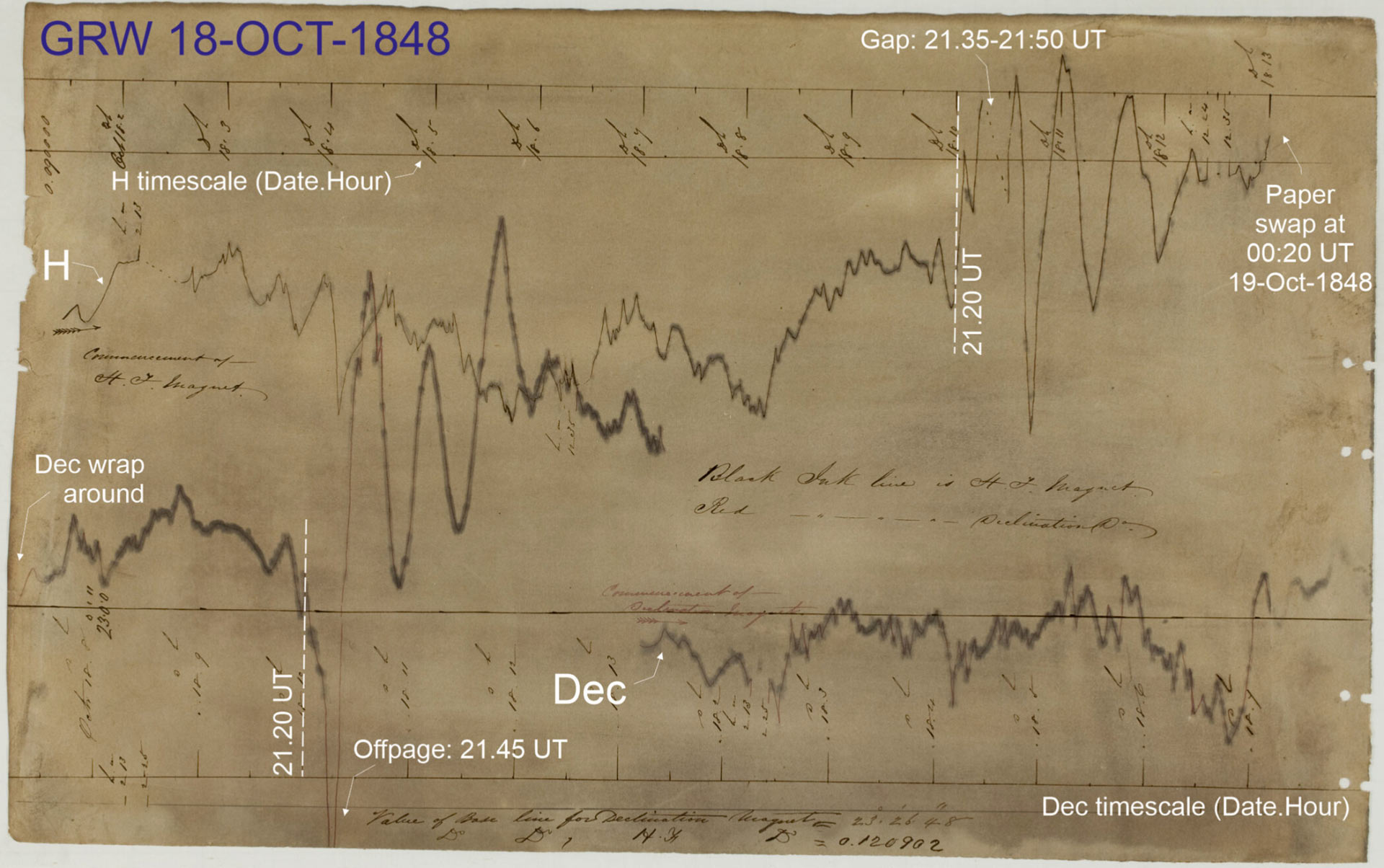
The magnetogram recorded at Greenwich Magnetic Observatory (London) from 11:20 UT on 18 October 1848 to 00:20 UT on 19 October 1848. Powerful geomagnetic disturbances are apparent on the evening of 18 October 1848 from 21:20 UT. Image credit: Wild et al., doi: 10.1029/2026SW005239.
“Space weather is recognized as a societal hazard that has evolved alongside the development of modern human technologies and infrastructure over the last two hundred years,” Professor Wild and co-authors said.
“The Carrington event of 1859 is recognized as one of the most powerful geomagnetic storms in the scientific record and was associated with the earliest and greatest solar flare ever recorded.”
“Although the Carrington storm caused widespread disruption to the electric telegraph systems of the day, it was not the first reported instance of solar activity interfering with the operation of technological infrastructure.”
“One of the earliest reported events was presented to the Royal Society (London) in May 1848,” they added.
“A 1849 report cites the occurrence of ‘spontaneous electrical currents’ in the electric telegraph equipment of the Midland Railway during the evening of March 19, 1847, when ‘a brilliant aurora was seen’ over the British Isles.”
In 1871, an anonymous author writing in the journal Nature published a study about ‘very intense magnetic disturbance’ on October 18, 1841, interfering with train signals and delaying the 10:05 pm departure from Exeter by 16 minutes because signalers couldn’t confirm the line was clear near the village of Starcross.
The timing of this account places it as the earliest known example of space weather affecting human technology.
If accurate, it would predate the previously earliest known case — the 1847 telegraph disruption on the Midland Railway — by six years.
Professor Wild’s team found a problem: the railway line in question didn’t open until 1846, five years after the alleged incident.
Digging through old timetables, magnetic observatory records, sunspot drawings and newspaper archives, the researchers pinpointed a four-month window when a 10:05 p.m. Exeter-Starcross train actually existed, and cross-referenced it against geomagnetic activity.
They found a strong match: October 18, 1848 saw a powerful magnetic storm recorded at the Greenwich Observatory, along with UK-wide aurora sightings and a large sunspot group observed from Durham.
They concluded the Nature report likely contained a typo — 1848 misprinted as 1841 — a mistake possibly made by telegraph engineer Nathaniel John Holmes, whom they identified as the probable author.
While no longer the earliest recorded case, the Exeter incident remains one of the first documented examples of space weather disrupting technology, with the 1847 Midland Railway event now restored as the earliest confirmed case on record.
“Space weather is often discussed as a modern challenge because of our dependence on technologies such as satellites, communications systems and electricity networks,” Professor Wild said.
“What this study shows is that society has been experiencing the effects of space weather on technology for almost as long as electrical technologies have existed.”
“The Exeter train delay is a fascinating story because it sits right at the point where emerging technologies first began to encounter the realities of the space environment.”
“By combining historical archives with scientific observations, we’ve been able to show that the event almost certainly happened in 1848 rather than 1841.”
“Although this means it is not the earliest recorded space weather impact, it remains one of the first clear examples of solar activity disrupting critical infrastructure.”
“It also demonstrates the value of combining scientific records with contemporary newspaper reports and archival documents when reconstructing historic space weather events.”
“Our research has a hint of a detective story — piecing together a wide range of archived records to better understand a historically severe space weather event,” said Dr. Mike Hapgood, visiting scientist and space weather expert at STFC’s RAL Space.
“It highlights the importance of preserving these older records, which give us the evidence base we need to interpret past events and strengthen future predictions.”
The team’s paper was published today in the journal Space Weather.
_____
James A. Wild et al. 2026. Did Space Weather Delay the 10:05 p.m. Train Departure From Exeter on 18 October 1841? Space Weather 24 (9): e2026SW005239; doi: 10.1029/2026SW005239