A pennaceous (vaned) feather trapped in Burmese amber about 99 million years ago, during the Cenomanian age of the Cretaceous period, is the longest three-dimensionally preserved example of its kind yet described.
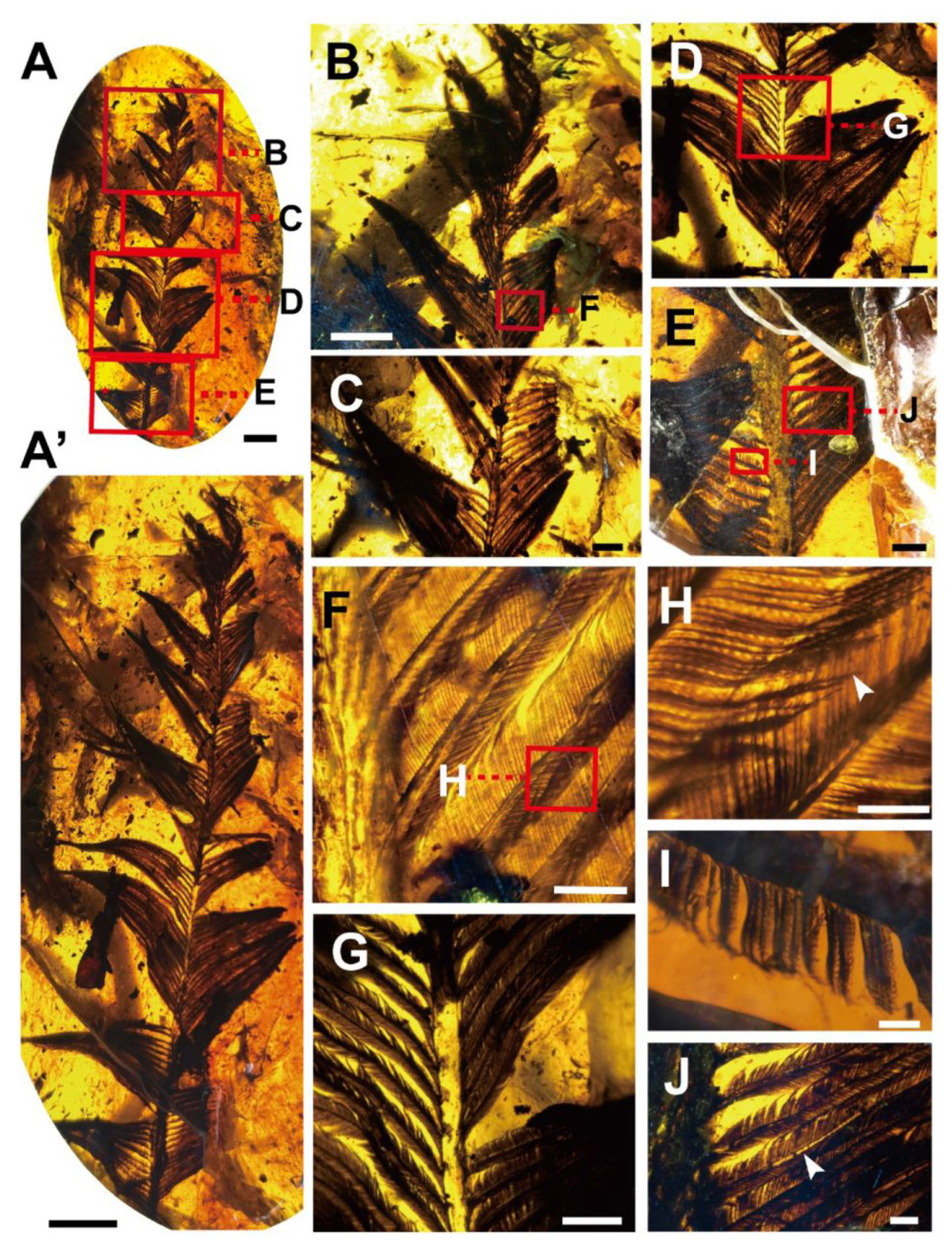
Morphology of ECNU A0033, the largest known pennaceous feather embedded in amber. Image credit: Zhang et al., doi: 10.1016/j.gr.2026.09.020.
“Feathers, the primary integumentary structures of non-avialan dinosaurs and birds, are highly diverse in morphology and function, with form strongly constraining functional performance,” said East China Normal University’s Professor Shuo Wang and colleagues.
“The emergence of pennaceous feathers is widely regarded as a key evolutionary innovation associated with the origin of remiges and/or rectrices during the theropod-bird transition and is therefore commonly regarded as a morphological proxy for flight capability.”
“However, how early feathers gave rise to modern pennaceous feather structures with optimized aerodynamic performance remains unclear.”
“Large pennaceous feathers are known primarily from pennaraptoran theropods, whereas more basal taxa such as Yutyrannus and Sinosauropteryx preserve only filamentous integuments without differentiation of rachises and vanes, consistent with the absence of aerodynamic function,” they added.
“Most large fossil feathers are preserved as carbonized compressions, in which fine structural details such as barbule hooklets and keratinous ultrastructure are seldom retained.”
“Accordingly, aerodynamic performance has largely been inferred from overall feather morphology, with limited direct assessment of how detailed feather architecture influences aerodynamic function.”
In the new study, the researchers analyzed a piece of Cretaceous amber from Myanmar that contains a pennaceous feather.
Catalogued as ECNU A0033, the specimen was donated in 2016 by an anonymous amateur collector to the Biology Museum of East China Normal University.
“The preserved portion of the included feather spans approximately 105 mm, with the maximum width of the symmetric vanes reaching about 40 mm,” the scientists said.
“Based on its overall proportions, the missing proximal segment is estimated to account for approximately one-quarter of its original length, suggesting that the complete feather likely exceeded 140 mm.”
The feather has two roughly symmetrical vanes, made up of densely packed branches called barbs.
Its overall appearance resembles that of modern flight-related feathers. But closer examination revealed important differences.
The tiny structures that normally connect neighboring barbs, known as barbules, lack hooklets, leaving the vanes without the interlocking arrangement that helps modern feathers maintain a continuous surface.
The feather’s central shaft, or rachis, also remained structurally incomplete. Rather than forming a fully enclosed, hollow structure, it had an open underside and lacked the internal tissue differentiation characteristic of modern feathers.
Computer simulations suggested that this open construction made the feather substantially more flexible under airflow than a model with a solid, cylindrical shaft.
The combination of features suggests that the different components of pennaceous feathers did not evolve all at once.
Instead, feather elongation and the development of organized vanes may have preceded the appearance of interlocking barbules and the fully differentiated tissues that improved mechanical strength and aerodynamic performance.
The finding challenges the assumption that an elaborate, symmetrical feather necessarily indicates an adaptation for flight.
The specimen had already acquired much of the external architecture associated with modern flight feathers, yet its internal construction and branching structures suggest that its aerodynamic capabilities were limited.
“ECNU A0033 provides direct fossil evidence that pennaceous feather evolution proceeded in a stepwise and modular manner,” the authors said.
“Its morphology shows that major components of pennaceous feather construction did not arise simultaneously: substantial elongation and a well-developed symmetrical vane were already established, whereas interlocking vane closure, cortical-medullary organization, and full rachial mechanical refinement remained incomplete.”
“This decoupled pattern indicates that feathers could achieve a superficially advanced overall appearance prior to the establishment of the tissue differentiation required for effective aerodynamic function.”
Professor Wang and co-authors also examined the specimen’s melanosomes, the pigment-bearing structures preserved in fossil feathers.
“The dark pigmentation of ECNU A0033 is consistent with previous reports of feather coloration in non-avian theropods and early birds, suggesting that dark or otherwise muted hues were widespread among feathered dinosaurs, including early birds,” they said.
The researchers could not identify the animal that carried the feather because it was not preserved alongside diagnostic skeletal remains.
“The feather type of ECNU A0033 is most consistent with non-avialan pennaraptoran theropods,” they said.
The team’s paper was published online October 31, 2026 in the journal Gondwana Research.
_____
Yanyun Zhang et al. The longest 3D-preserved Cretaceous plumage reveals stepwise pennaceous feather evolution. Gondwana Research, published online October 31, 2026; doi: 10.1016/j.gr.2026.09.020