Paleontologists working in Patagonia, Argentina, have uncovered fossilized eggshells that push the known range of dinosaur nesting deeper into the southern hemisphere than previously documented.
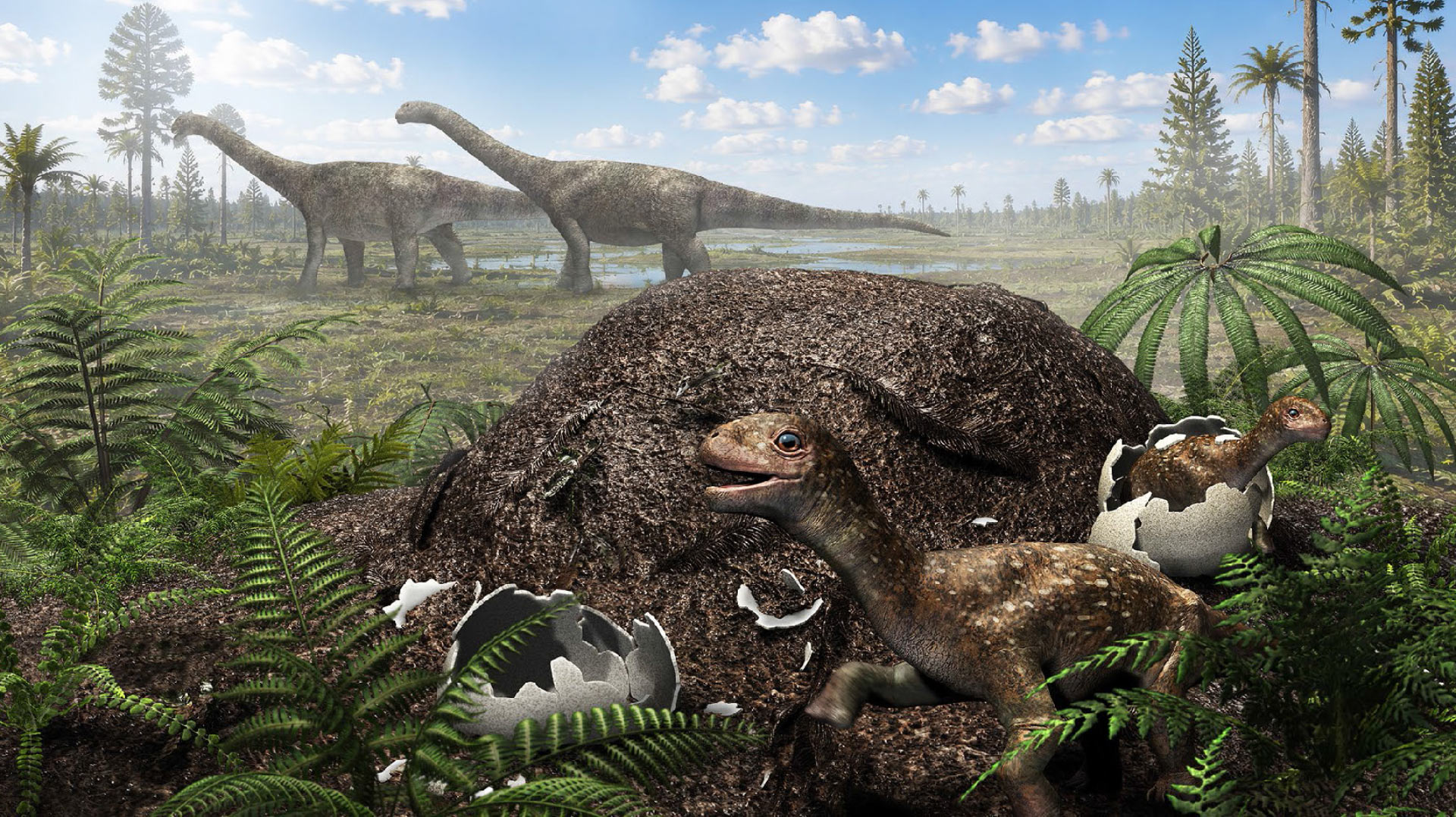
Titanosaur hatchlings emerging from a nest in the Cretaceous of Patagonia, Argentina. Image credit: Masato Hattori.
“Few discoveries have yielded fossil evidence of non-avian dinosaurs nesting at high paleolatitudes,” lead author Dr. Kohei Tanaka from the University of Tsukuba and colleagues wrote in their paper.
“Such paleoenvironments probably posed nesting challenges because of low seasonal temperatures and prolonged periods of reduced sunlight, where dinosaurs probably would have adopted various reproductive strategies for egg incubation.”
“Among non-avian dinosaurs, nesting in northern polar paleoenvironments is evidenced by hadrosaur and theropod eggshells recovered from a Late Cretaceous site in Siberia representing approximately 70-75 degrees north paleolatitude, as well as theropod perinatal bones and small hadrosaur tracks and perinatal bones from Upper Cretaceous deposits of Alaska.”
“Furthermore, fossilized eggshell and perinatal bones of hadrosaur and theropod dinosaurs found in Alberta, Canada, indicate relatively high-latitude nesting at approximately 57-65 degrees north.”
“While these discoveries indicate nesting at northerly latitudes, less evidence exists for high-latitude nesting in the southern hemisphere, in part owing to the lack of definitive dinosaur eggshells/eggs from the regions of Antarctica or Australia.”
In the study, the paleontologists examined more than 250 dinosaur eggshell fragments recovered from the Chorrillo Formation in Argentina’s Santa Cruz province.
During the Maastrichtian age of the Cretaceous period, about 70 million years ago, the site was at an estimated paleolatitude of 55 to 60 degrees south — closer to the pole than any other place on Earth known to preserve definitive dinosaur eggs in the southern hemisphere.
The fragments belong to an egg type (oogenus) called Fusioolithus, a form long associated with titanosaurs, the group that includes some of the largest animals ever to walk the Earth.
Although no eggshells were found directly with skeletal remains, titanosaur bones and teeth have been recovered from the same site, supporting the likely connection.
“The Chorrillo Formation represents, to our knowledge, the highest paleolatitude area to produce definitive dinosaur egg remains from the southern hemisphere and reveals that titanosaurs were nesting at higher latitudes than previously known,” the researchers said.
Using microscopy and micro-CT scanning, they measured the shells’ thickness, surface ornamentation and pore structure.
They found the eggshells were highly porous, a trait shared with other titanosaur eggs and modern animals such as crocodilians and megapode birds that bury their eggs rather than sit on them.
Such porosity indicates the eggs from the Chorrillo Formation were fully covered by nesting material during incubation, most likely in mound-style nests.
“The eggs, as shown by a high eggshell porosity, would have been incubated in nests buried by nesting materials and would have used the heat generated by decaying vegetation,” the scientists said.
“A similar nesting style has also been inferred for non-brooding dinosaurs in high-northern paleolatitudes, where sufficient heat from solar radiation was probably unavailable.”
The team’s paper appears in the journal Royal Society Open Science.
_____
Kohei Tanaka et al. 2026. Titanosaur eggshells from the latest Cretaceous of Patagonia, Argentina: implications for nesting at high latitude. R. Soc. Open Sci 13 (9): 260333; doi: 10.1098/rsos.260333