Trogons — a group of colorful, medium-sized birds that live in tropical and subtropical forests around the world — are recognizable by an odd feature: a foot in which the second toe is permanently reversed. A newly described trogon species from the Early Eocene of Denmark, one of the earliest members of the group, lacked a fully reversed second toe.
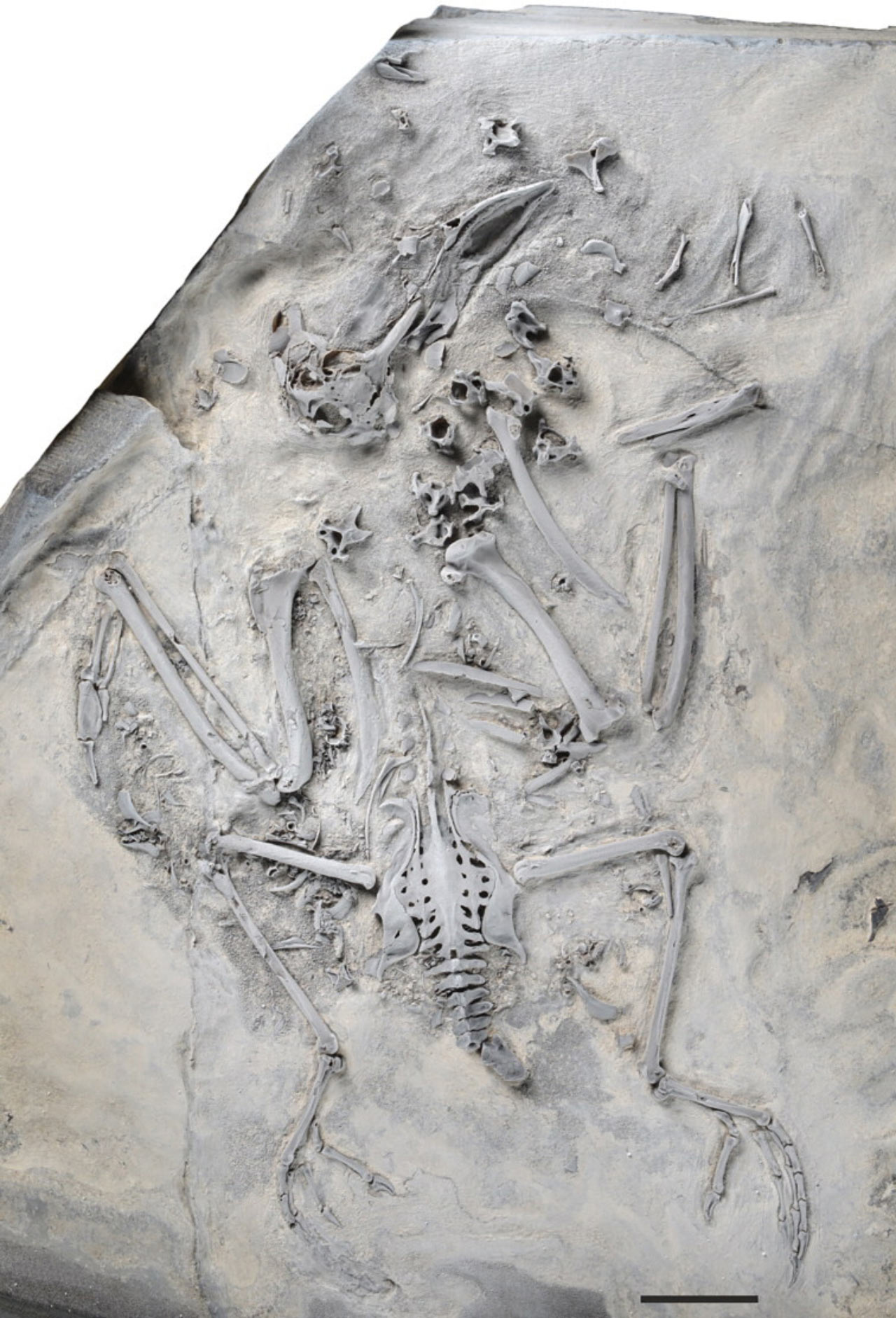
The holotype of Daniatrogon kochi from the Early Eocene Fur Formation in Denmark. Scale bar – 10 mm. Image credit: Gerald Mayr, doi: 10.1080/14772019.2026.2727037.
Daniatrogon kochi lived in what is now Denmark during the Early Eocene epoch, roughly 55 million years ago.
The most striking trait of the new species is its feet. In modern trogons, the second toe points backward and, together with the big toe, opposes the other two forward-facing toes, an arrangement known as heterodactyl.
In Daniatrogon kochi, the claw of the second toe points the same way as those of the other front toes, though the toe may have been rotated slightly inward.
Every other fossil trogon known from articulated skeletons has a fully reversed second toe.
Because the heterodactyl foot appears only in trogons, it must have evolved along the lineage leading to them, and Daniatrogon kochi offers a rare glimpse of the stage before that happened.
“Trogons are a group of birds, which is today found in tropical and subtropical areas of Africa, Asia and the Americas,” Dr. Gerald Mayr from the Senckenberg Research Institute and Natural History Museum Frankfurt wrote in his paper.
“These colorful and predominantly insectivorous or frugivorous birds are well characterized by their heterodactyl foot, in which the second toe is permanently reversed and, together with the hallux, opposes the two other fore toes.”
“Disregarding a likely erroneous identification of a heterodactyl foot in an Early Cretaceous enantiornithine and a likewise yet to be corroborated record from an Early Oligocene strigiform bird, this diagnostic feature is unique to trogons, which also exhibit various other derived morphological characteristics.”
A nearly complete skeleton of Daniatrogon kochi was found in 1989 on a beach on the Danish island of Mors by the fossil collector Karsten Koch, for whom the bird is named.
The fossil came from rocks of the Early Eocene Fur Formation.
“Trogons have a comparatively comprehensive Early Paleogene record,” Dr. Mayr wrote.
“The oldest fossils stem from the Early Eocene Fur Formation in Denmark and the roughly coeval sediments of the London Clay of Walton-on-the-Naze in England.”
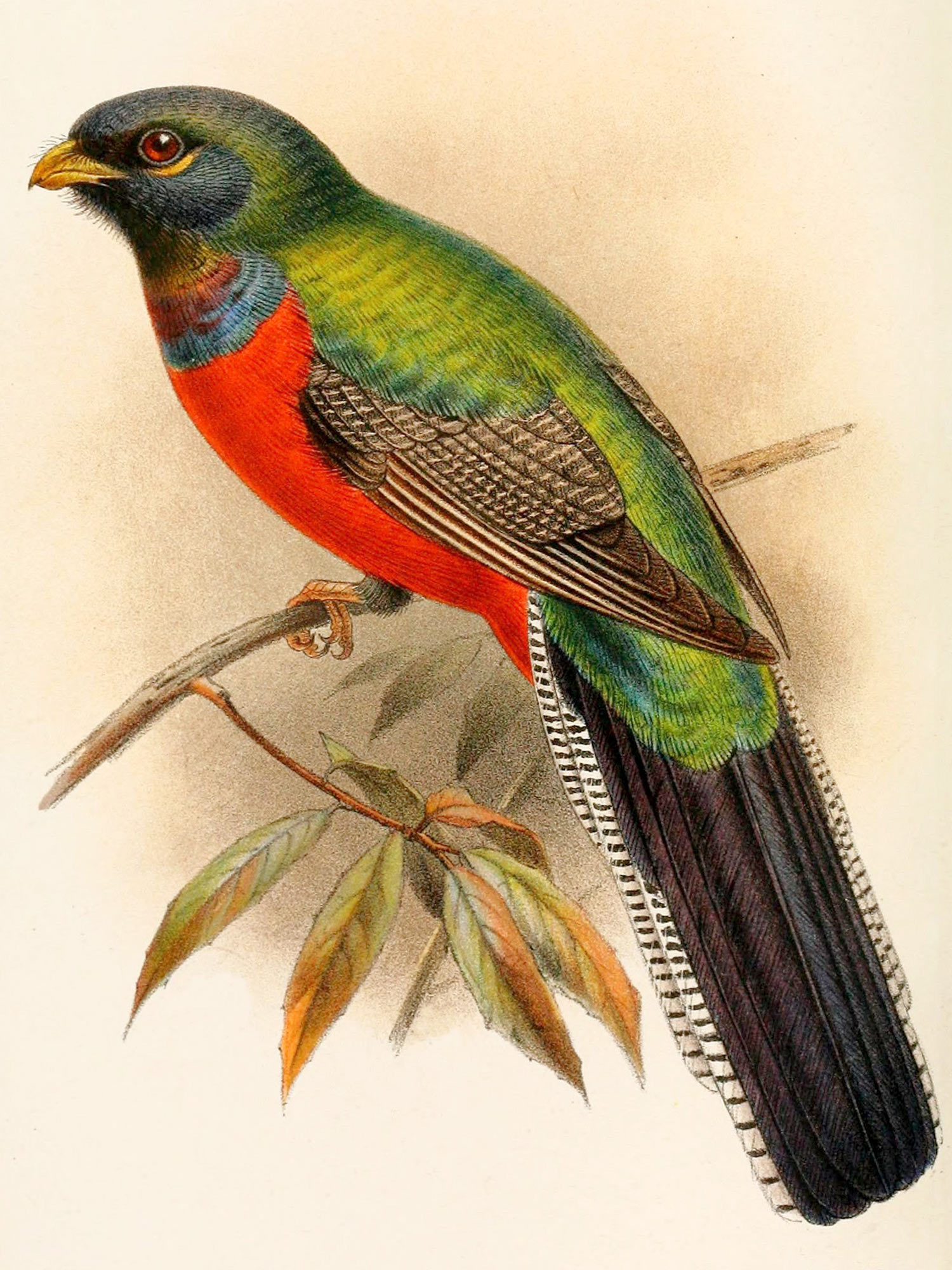
Reconstruction of the living bar-tailed trogon (Apaloderma vittatum) in the Catalogue of the Birds in the British Museum.
Daniatrogon kochi overturns some assumptions about why trogons have their peculiar feet.
The heterodactyl foot has generally been considered a perching adaptation that compensated for a weak big toe.
But the new species had a very long big toe, as did the Messel trogon Masillatrogon, suggesting that the toe shrank only after trogons acquired their reversed second toe.
Dr. Mayr proposes that early trogons moved more actively through branches and vegetation while foraging, a lifestyle in which a strong grasping foot would help.
“Living trogons are rather sedentary birds, which forage by sallying flights from perches,” the researcher wrote in the paper.
“Stem-group trogoniforms may have been more actively moving in the branches and through the vegetation while searching for food — activities for which an enhanced grasping function of the foot would have been advantageous.”
“Therefore, size reduction of the hallux (big toe) in trogoniforms may have been related to the acquisition of a more sedentary way of living, as sallying substrate-gleaners, for which a single well-developed reversed toe — the second one — is sufficient for perching.”
Daniatrogon kochi and other early trogons had narrower, less-ossified beaks than living species, which use their bills to excavate nesting cavities in soft, rotting wood.
Dr. Mayr suggests the early species may have nested in existing holes or dug in soil with their feet, as some of their relatives do.
The finding indicates that the foot changed before the beak widened.
“The narrower beak of Daniatrogon, Eotrogon and Primotrogon — as compared to extant Trogonidae — possibly indicates that these stem-group trogoniforms built their nests in existing holes or that they used their syndactyl feet to excavate nesting cavities in soil,” he wrote.
According to the study, early trogons were more ecologically varied than their living relatives, with a greater diversity of beak and foot shapes.
The trogon lineage is estimated to have split from that of hornbills and hoopoes about 62 million years ago, and early members of the two groups look strikingly alike below the neck.
“The main differences between early Trogoniformes and the earliest Bucerotiformes (hoopoes, hornbills and allies) concern skull features, which may indicate that the divergence of the Trogoniformes and Bucerotiformes was initially driven by disparate feeding specializations,” Dr. Mayr concluded.
His paper was published on September 21, 2026 in the Journal of Systematic Palaeontology.
_____
Gerald Mayr. 2026. Evolution of a morphological novelty: exceptional skeleton of an early Eocene trogon (Aves: Trogoniformes) elucidates the origin of a unique foot morphology. Journal of Systematic Palaeontology 24 (2): 2727037; doi: 10.1080/14772019.2026.2727037