Scientists have created a digital facial approximation of the Jebel Irhoud hominin, whose remains are dated to about 315,000 years ago.
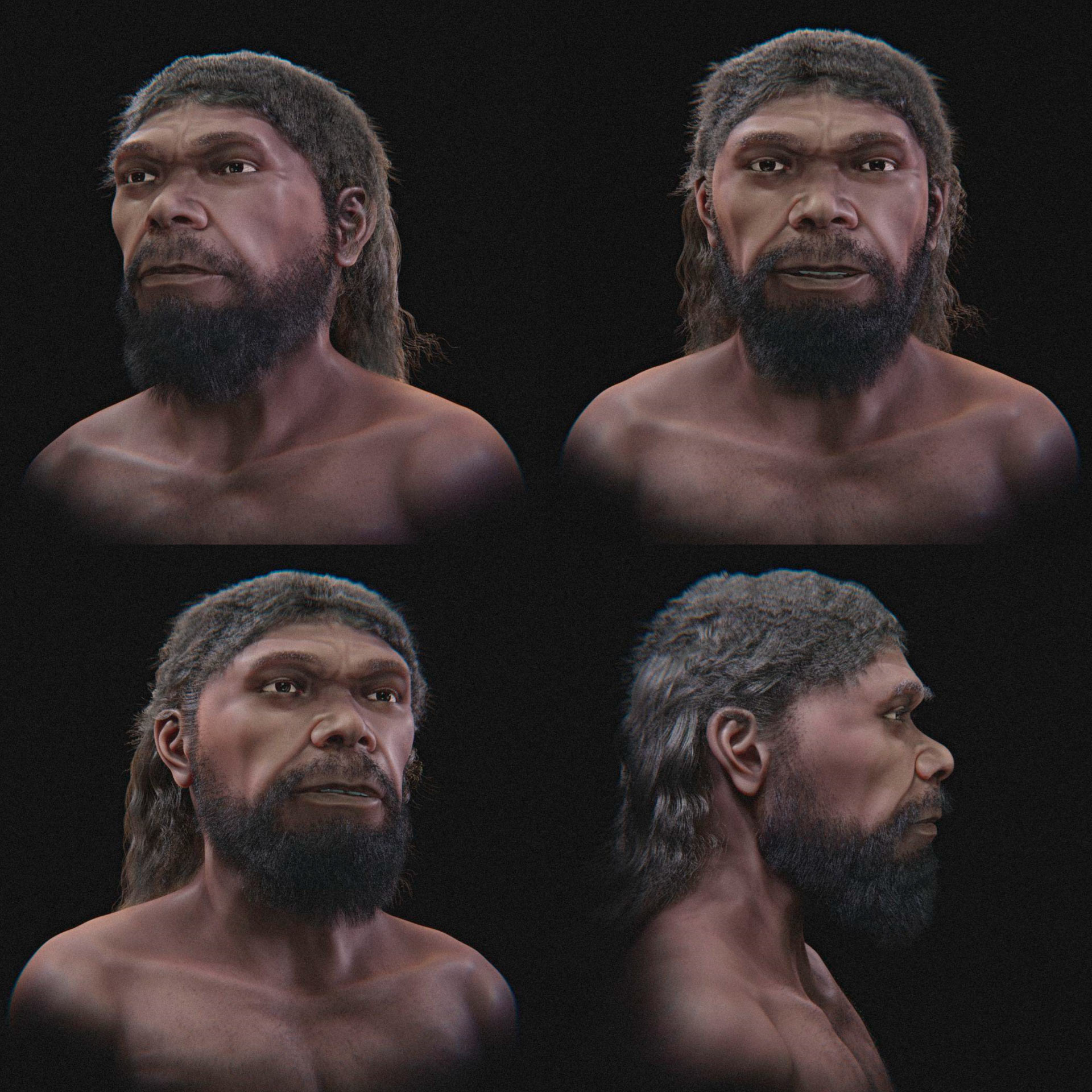
Facial approximation of the Jebel Irhoud hominin. Image credit: Moraes et al., doi: 10.3390/heritage9090369.
In the early 1960s, a worker extracting minerals at Jebel Irhoud, in Morocco, uncovered a skull with strikingly human features.
Named Irhoud 1, the fossil was initially identified as an African Neanderthal variant about 40,000 years old.
Later dating studies pushed the age of the find back, to between 100,000 and 200,000 years in 1991 and to about 160,000 years in 2007.
In 2017, two studies reclassified Irhoud 1 and associated remains as Homo sapiens and gave them an age of roughly 315,000 years, making them the oldest known representatives of the species.
“In 2017, the Max Planck Institute for Evolutionary Anthropology (MPI-EVA) publicly released image and video data regarding the three-dimensional digital reconstruction of the Jebel Irhoud skull,” said corresponding author Dr. Johari Yap Abdullah, a researcher at the Universiti Sains Malaysia and Saveetha University, and his colleagues.
“The three-dimensional model in question constitutes a composite skull, structured through the spatial integration of multiple specimens excavated from the same stratigraphic unit.”
The MPI-EVA model is dominated by the Irhoud 1 fossil, the original 1961 find, which supplies the braincase and upper face.
A mandible from another individual, Irhoud 11, and fragments from other specimens fill the gaps.
“Irhoud 1 serves as the primary framework of the model, ensuring the anatomical integrity and volumetric orientation of the composite skull, while Irhoud 11, Irhoud 10, Irhoud 21, and Irhoud 22 act as structural completion elements — all originating from the same population, the same archeological layer, and anatomically compatible with one another,” the researchers explained.
Using the data from the MPI-EVA’s release, they built a 3D model of the composite Irhoud skull through photogrammetry.
They then reshaped a CT scan of a modern adult donor to match it, a technique called constrained anatomical deformation, and applied soft-tissue thickness data drawn from people of African ancestry.
A byproduct of the method was an estimate of the brain cavity’s volume: 1,364 milliliters. This is consistent with a 2018 measurement taken directly from CT scans of the fossil, which found 1,375 milliliters, and falls within the range seen in modern humans.
“Several studies on the endocranium of Irhoud 1 have been conducted over recent decades, indicating a volume range between 1,305 and 1,480 milliliters,” the scientists said.
They produced two sets of images: one is a neutral grayscale rendering with no hair, meant to show how the face relates to the underlying bone; the other is a colored version with skin tone, hair and a beard.
The second set is artistic and speculative: skin pigmentation, lighting and hair are not grounded in evidence from the fossil, but reflect conventions informed by studies of archaic and modern populations.
“Our study demonstrated the feasibility and reproducibility of forensic facial approximation and morphometric analysis of the Jebel Irhoud hominin based on data from a three-dimensional composite skull,” the authors said.
“Presenting the results through two complementary approaches — a neutral grayscale version focused on anatomical rigor and a colored artistic depiction — successfully bridges scientific precision with the requirements of public outreach.”
“Ultimately, the findings reinforce that open-source tools and transparent methodological workflows provide a robust, accessible, and anatomically coherent alternative for the paleoanthropological investigation and reconstruction of complex Middle Pleistocene fossil specimens.”
The team’s work was published online September 13, 2026 in the journal Heritage.
_____
Cicero Moraes et al. 2026. Digital Facial Approximation of Jebel Irhoud Composite Skull (~315,000 BP). Heritage 9 (9): 369; doi: 10.3390/heritage9090369