A team of marine biologists from the Netherlands, Germany, Denmark and Ukraine has discovered two new species of tardigrades living on a seamount in the Atlantic Ocean.
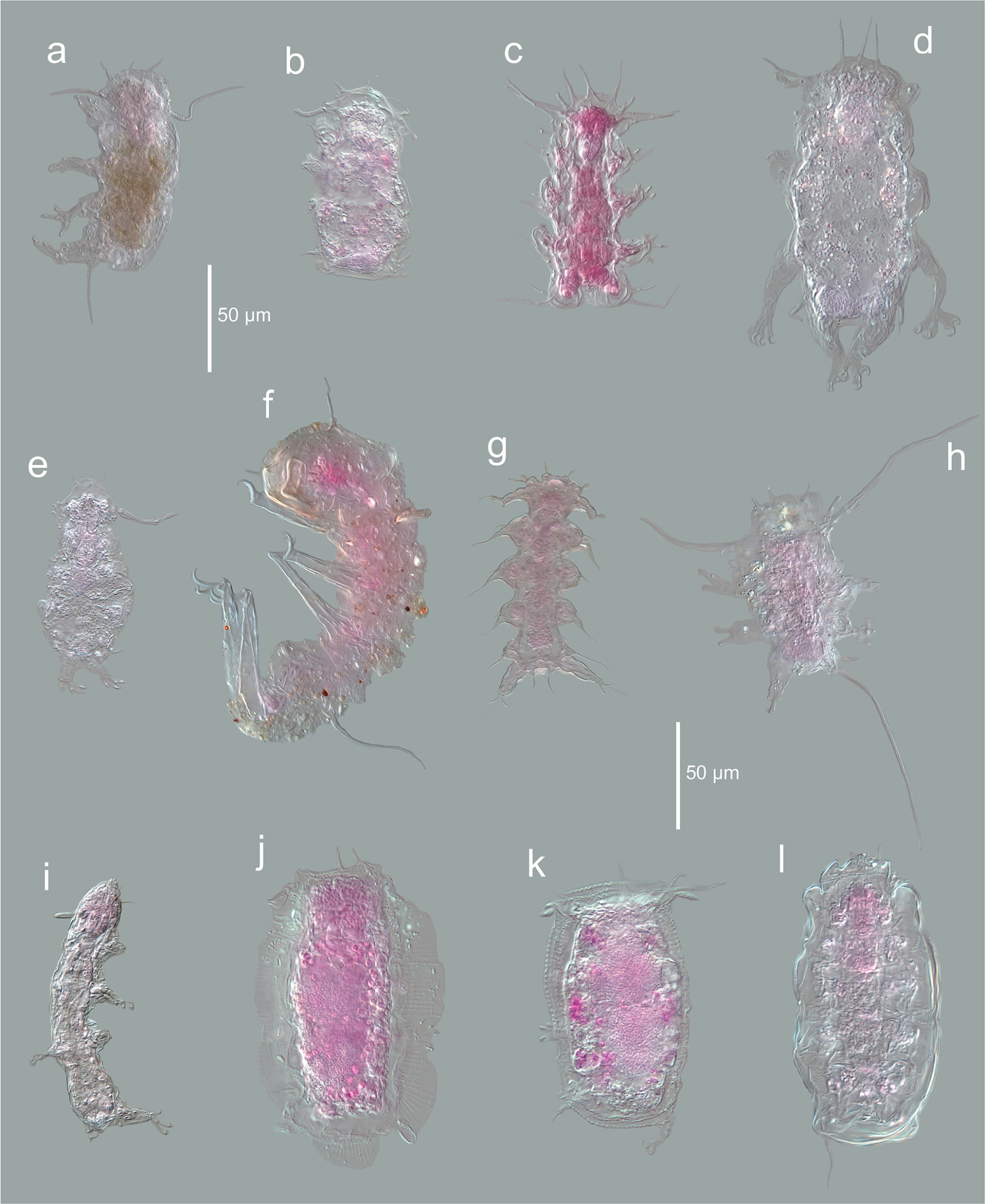
Marine tardigrade from Senghor Seamount, including two new species: Megastygarctides hekatae (f) and Parastygarctus potercha (g). Image credit: Trokhymchuk et al., doi: 10.3897/zookeys.1295.205902.
Most people who have heard of tardigrades picture the so-called water bears of moss and lichen, hardy terrestrial animals famous for surviving extreme conditions.
But the group is far broader than that. Many tardigrades live in the sea, where they inhabit the spaces between sand grains and other seafloor sediments, from shallow coastal waters to the deep ocean.
The marine forms belong largely to a separate lineage, the Heterotardigrada, and they are often strikingly different from their land-dwelling cousins: some have armor-like plates, elaborate sensory appendages and ornate claws.
The two new species of marine tardigrades, Megastygarctides hekatae and Parastygarctus potercha, inhabit Senghor Seamount, an undersea volcanic peak in the Cabo Verde region off West Africa.
The samples were collected in 2009 during a research cruise of the German vessel Meteor.
“We detected the two new species in sediment samples collected during an expedition aboard the research vessel Meteor at Senghor Seamount,” said lead author Dr. Roman Trokhymchuk, a researcher at the Dutch Naturalis Biodiversity Center and the German Centre for Marine Biodiversity Research, Senckenberg am Meer.
“Our study thus provides the first systematic investigation of the marine tardigrade fauna at this seamount.”
Dr. Trokhymchuk and colleagues identified a total of 20 types of tardigrades in sediment from the seamount’s summit, roughly 100 to 130 m below the surface.
By contrast, a deep-sea site about 100 km to the north, at a depth of nearly 3,300 m, yielded just two.
One of the new species, Megastygarctides hekatae, measures less than 200 micrometers.
It is notable for rare spine-like structures near its genital opening, a feature previously known in only one other tardigrade species.
The other, Parastygarctus potercha, is even smaller, about 70 micrometers long. It appears to retain juvenile traits, such as fewer claws than most of its relatives, even as adults.
“We identified a total of 20 different taxa. This supports our hypothesis that such undersea mountains also represent particularly species-rich habitats for marine tardigrades,” Dr. Trokhymchuk said.
“The marked difference in the number and diversity of tardigrades we found on the plateau and on the deep-sea floor is further evidence that seamounts can be veritable oases of biodiversity — even for organisms that are barely visible to the naked eye,” added Dr. Alexander Kieneke, a marine scientist at the German Centre for Marine Biodiversity Research, Senckenberg am Meer.
“On the Faroe Bank, another plateau in the Atlantic, as many as 35 species of tardigrades have been documented. However, the deep sea remains largely unexplored.”
“It is therefore reasonable to assume that biodiversity in other regions has been underestimated to date.”
The team’s paper was published online in the journal ZooKeys.
_____
R.R. Trokhymchuk et al. 2026. Marine tardigrades (Heterotardigrada) from Senghor Seamount, Eastern Tropical Atlantic, with the description of two new species from the taxon Stygarctidae. ZooKeys 1295: 333-358; doi: 10.3897/zookeys.1295.205902