Potatoes (Solanum tuberosum) can complete their life cycle in simulated lunar soil and produce tubers that look nutritionally normal, as long as the soil is mixed with some organic matter, according to a new study from Oregon State University.
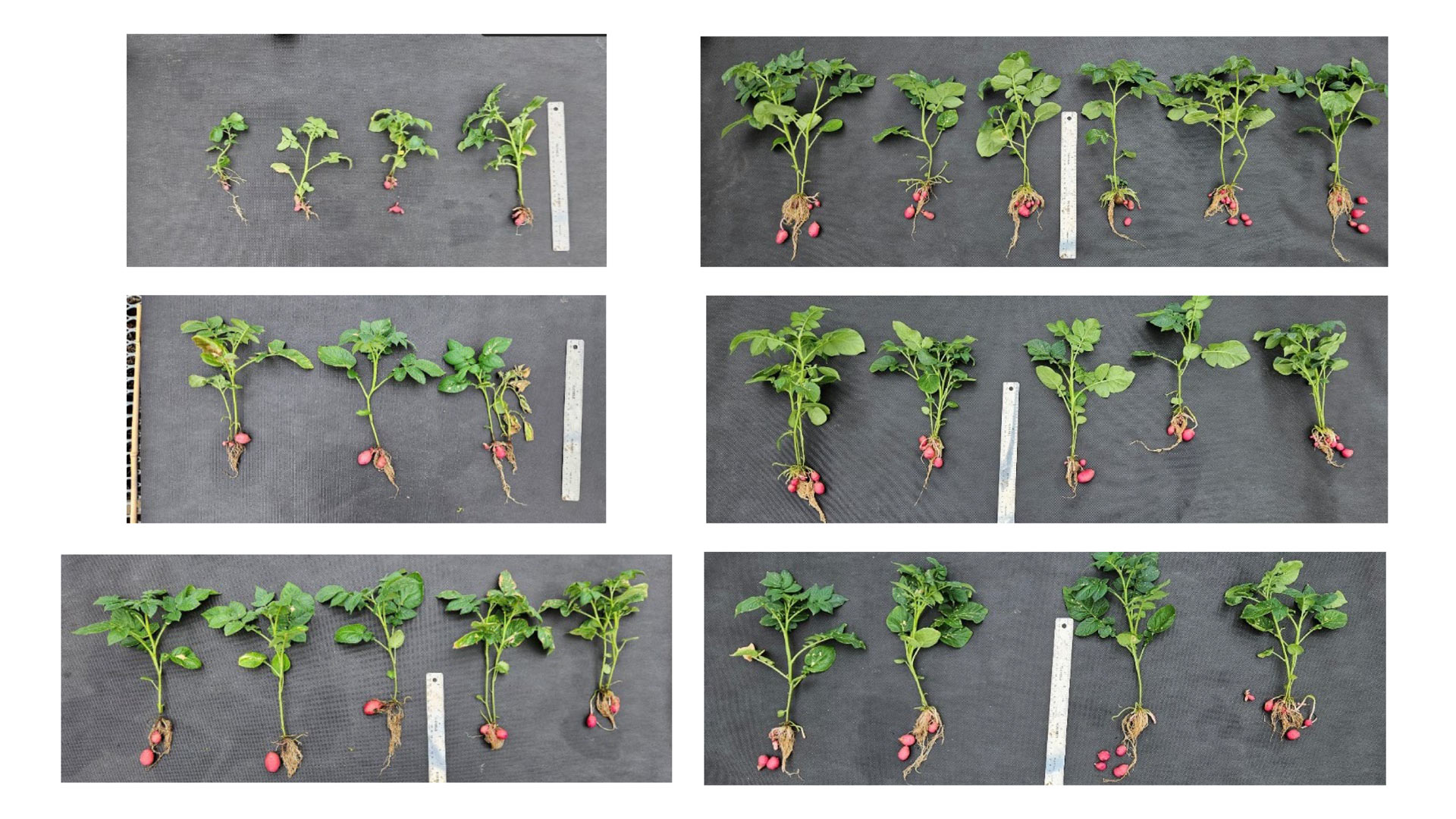
Growth and development phenotype of potato plants grown in LMS-1E and Adkins soil with or without amendment with vermicompost; post-harvest images of potato plants grown in LMS-1E (left) and Adkins soil (right), in 100%, 85%, or 70% regolith to compost volume ratios. Image credit: Handy et al., doi: 10.1038/s41526-026-00668-z.
“We found that potatoes can complete their entire life cycle in simulated lunar soil when supplemented with organic matter,” said Oregon State University researcher Aymeric Goyer, senior author of the study.
“That’s an important step toward developing reliable food production systems that could support long-term human exploration of the Moon.”
In the study, the scientists tested the Modoc potato variety in five types of lunar regolith simulants, both ‘mare’ (basalt) and ‘highlands’ types, alongside a control of Earth soil from Oregon’s potato-growing region.
The results were stark for plants grown in pure simulant. In 100% LMS-1E, a mare simulant, plants were stunted and had barely any roots.
The authors suspect copper toxicity, since leaves and tubers from those plants accumulated more copper.
Adding vermicompost (worm castings) changed the picture: a mix of 70% simulant and 30% compost produced plants comparable to those grown in Earth soil.
“We believe the compost helps balance some of the toxicity we see in lunar regolith by reducing plant exposure to harmful compounds,” said study’s first author Dr. David Handy, a postdoctoral researcher at Oregon State University.
In a second experiment using only 5% compost, all five simulants still reduced tuber yield compared with Earth soil.
A highlands simulant called NUW-LHT-5M did the worst. Plants emerged about 24 days after planting, compared with 4 to 8 days in the other simulants, and only three of five plants produced tubers.
Each simulant triggered a different pattern of changes, suggesting the stress plants feel depends on the type of regolith.
The food itself held up better than the plants did: tuber metabolite profiles showed only minor differences from the control, and levels of the potato toxins solanine and chaconine, which can rise when plants are stressed, did not increase significantly.
Some tubers did contain more copper and zinc, and those grown in two highlands simulants had more aluminum.
The findings support the idea that crops could one day be grown in lunar soil for NASA’s planned long-term presence on the Moon.
“This is the first report to simultaneously characterize growth, transcriptomic, and metabolomic responses of potato tomultiple lunar regolith simulant types, and the first to provide evidence that tubers produced in lunar regolith simulants are nutritionally comparable to those grown in terrestrial soil, a critical step toward validating lunar food production for long-duration human exploration,” the researchers concluded.
Their findings appear in the journal npj Microgravity.
_____
D. Handy et al. 2026. Growth and molecular responses of potato to lunar regolith simulants. npj Microgravity 12, 100; doi: 10.1038/s41526-026-00668-z