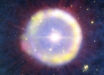
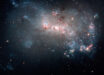
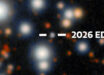
Named Nāpōwawāʻenakaulua, the compact pair contains two rapidly feeding supermassive black holes separated by just 18,100 light-years. Their existence so early in cosmic history challenges current models of black hole formation.
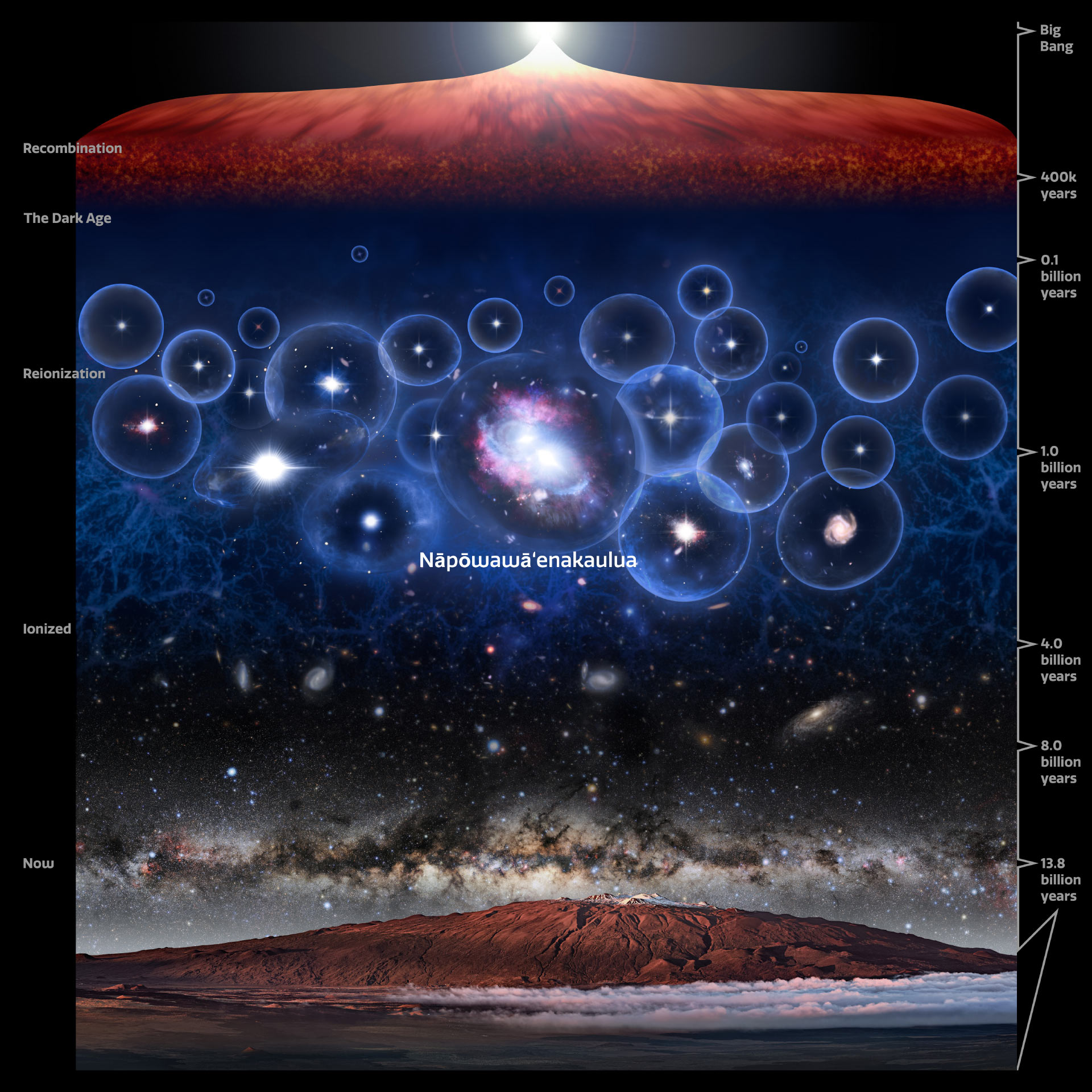
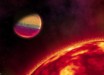
An artist’s impression of Nāpōwawāʻenakaulua, the oldest compact pair of quasars ever observed. Image credit: International Gemini Observatory / NOIRLab / NSF / AURA / P. Marenfeld / M. Zamani.
The Nāpōwawāʻenakaulua pair, also known as J1602+4228AB, is separated by a distance of approximately 18,100 light-years, or roughly one-fifth the diameter of the Milky Way Galaxy.
The quasars, J1602+4228A and J1602+4228B, have masses of 1.5 billion and 400 million times that of the Sun, respectively.
Their distance from us places them at only 900 million years after the Big Bang.
Nāpōwawāʻenakaulua is only the third known quasar pair found at cosmic dawn. During this period, the Universe’s first stars, galaxies, and black holes were still relatively young.
The extreme mass of the pair at this time therefore challenges our current understanding of how large-scale cosmic structures are formed.
“There is no definitive theoretical explanation for how a single one of these giant quasars exists so early in the age of our Universe, much less two,” said Dr. Silvia Onorato, a postdoctoral researcher at NSF’s NOIRLab.
“We observed Nāpōwawāʻenakaulua at a time when the Universe was only a thirteenth of its age and astonishingly, its supermassive black holes are just as massive as those we see today.”
The discovery was made in the data collected by the Near-Infrared Spectrograph Integral Field Unit onboard the NASA/ESA/CSA James Webb Space Telescope.
Follow-up observations with Gemini North telescope’s Gemini Near-Infrared Spectrograph (GNIRS) allowed the astronomers to resolve the two quasars as individuals.
Additional data from the Gemini Multi-Object Spectrograph (GMOS) further constrained the properties of the quasar pair.
The researchers propose that this rare quasar pair may serve as a signpost of an extreme peak in the matter density field of the early Universe, where galactic interactions simultaneously fed star formation and the rapid growth of the black holes.
“Nāpōwawāʻenakaulua is a really unique environment,” Dr. Onorato said.
“It’s a laboratory for astronomers to study how the very first massive galaxies and their central black holes assembled together through direct galaxy interactions during these early times.”
The findings appear in the Astrophysical Journal Letters.
_____
Silvia Onorato et al. 2026. Nāpōwawā‘enakaulua: A Close Quasar Pair at Cosmic Dawn in the Aether Survey. ApJL 1011, L59; doi: 10.3847/2041-8213/aeb11f