Crowded star clusters in the early Universe could have built giant stars, seeded black holes and fed the mysterious little red dots, according to a team of astrophysicists led by University of California. Los Angeles doctoral student Claire Williams.

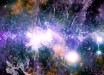
This artist’s impression shows a field of Population III stars as they would have appeared a mere 100 million years after the Big Bang. Image credit: NOIRLab / NSF / AURA / J. da Silva / Spaceengine.
“Little red dots are a hot topic in astronomy. You can compare studies of people trying to understand LRDs to the tale of blind people who are trying to describe an elephant by touching it, and each person describes it differently based on what part they’re touching,” said University of California, Los Angeles astrophysicist Smadar Naoz.
“Our research connects several of those perspectives together and may help us see more of the elephant.”
For the study, the authors built a radially resolved analytic model of stellar collisions in dense, high-redshift systems.
These include the ancestors of globular clusters, nuclear star clusters like the one around the Milky Way’s central black hole, and the compact, reddish LRDs.
Rather than starting from observations, the team drew initial conditions from high-resolution cosmological simulations.
They then checked their predictions against Monte Carlo simulations and found good agreement across key regimes.
In clusters without a black hole, collisions tend to be gentle mergers rather than destructive smash-ups.
The model finds that merger products sink toward the center through dynamical friction, where repeated collisions can build what astronomers call a very massive star.
For clusters above roughly 100,000 solar masses per cubic parsec, nearly all the low-mass systems the team tested could form a very massive star heavier than 200 suns.
In the densest cases, the star grew past 100,000 solar masses. Such a star could collapse into an intermediate-mass or even supermassive black hole.
“Perhaps the strangest outcome of our simulations is that stars can merge repeatedly within the cluster until they form one gigantic star with a mass equal to that of an entire cluster,” Williams said.
“When a star this huge reaches the end of its life, models suggest that it may have no option but to collapse into itself and form a massive black hole.”
“One place in the nearby Universe where collisions between stars are common is the Galactic center.”
“In our model, once these very massive stars turn into intermediate-mass black holes, the system resembles our own galactic center, which is a black hole surrounded by a dense star cluster.”
The astronomers also compared their model to lensed star clusters the NASA/ESA/CSA James Webb Space Telescope has observed at high redshift.
Most form only modest very massive stars, but the most compact could reach 1,000 to 10,000 solar masses.
According to the team, the picture changes when a massive black hole is already present. Its gravity speeds up stars in the inner regions so much that collisions become destructive, ripping stars apart and spilling their material into the surrounding space.
This process can rapidly pile up extremely dense gas around the black hole, at densities matching or exceeding those inferred for LRDs.
The gas could be a ready fuel supply, and it could help explain why LRDs look the way they do.
“We show that high rates of destructive collisions can rapidly build up extremely dense gaseous environments around massive black holes, potentially providing an analog to the observed population of LRDs,” the researchers concluded.
The study was published October 26 in the Astrophysical Journal.
_____
Claire E. Williams et al. 2026. A Cosmological Framework for Stellar Collisions at High Redshift in Proto-globular Clusters, Nuclear Star Clusters, and Little Red Dots. ApJ 1012, 1; doi: 10.3847/1538-4357/aea577