Using the Dark Energy Camera on NSF’s Víctor M. Blanco 4-m telescope, astronomers have photographed a supernova remnant that looks remarkably like a betta fish swimming through the cosmos.
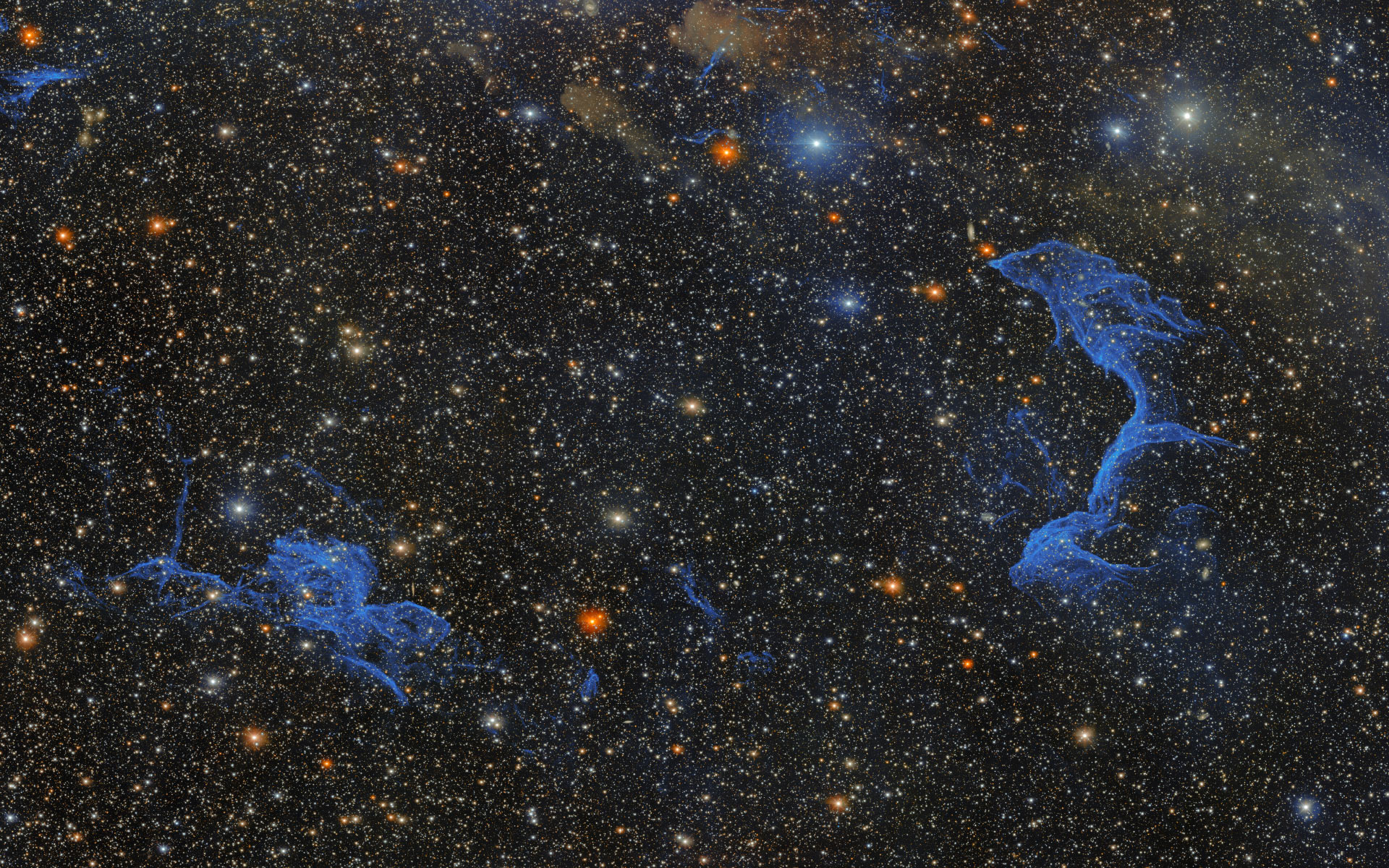
This image shows a close-up view of one portion of the supernova remnant SNR G295.5+09.7, nicknamed the Betta Fish Nebula. Image credit: CTIO / NOIRLab / DOE / NSF / AURA / T.A. Rector, University of Alaska Anchorage / D. de Martin & M. Zamani, NSF’s NOIRLab.
The Betta Fish Nebula is located approximately 6,800 light-years away in the southern constellation of Centaurus.
Formally known as SNR G295.5+09.7, the object was photographed by the Dark Energy Camera (DECam), a high-performance imager mounted on NSF’s Víctor M. Blanco 4-m telescope at Cerro Tololo Inter-American Observatory in Chile.
“Nebulae are luminescent clouds of matter floating in the interstellar medium that are formed from gas, dust, and stellar material,” the astronomers said in a statement.
“This nebula may not have been imaged by a professional observatory before, making this image the first of its kind.”
As its technical name suggests, SNR G295.5+09.7 is the aftermath of a supernova.
When the star detonated, its outer layers were blasted into space. The material expanded into the interstellar medium, slamming into surrounding gas and making it glow. This interaction created the blue filaments visible today.
The star’s remaining core could not withstand its own gravity and collapsed. However, the collapse stopped short of forming a black hole, as a neutron star formed instead.
“Total collapse was avoided through the formation of a neutron star, which sits in this image encircled by the outer shell of the nebula,” the researchers said.
“Neutron stars are incredibly small and incredibly dense. They pack about 1.4 times the mass of our Sun into a sphere 20 km (12 miles) in diameter.”
The Betta Fish Nebula sits within the Carina-Sagittarius arm of the Milky Way.
“In this image, thousands of stars from this arm rest in the background of the nebula,” the scientists said.
“Hidden within the stellar multitude are galaxies outside of our own.”