Astronomers using the Atacama Large Millimeter/submillimeter Array have captured stunning new images of the surface of Betelgeuse, the famous red supergiant star in the constellation Orion, revealing persistent hot patches and a distorted, non-spherical atmosphere.
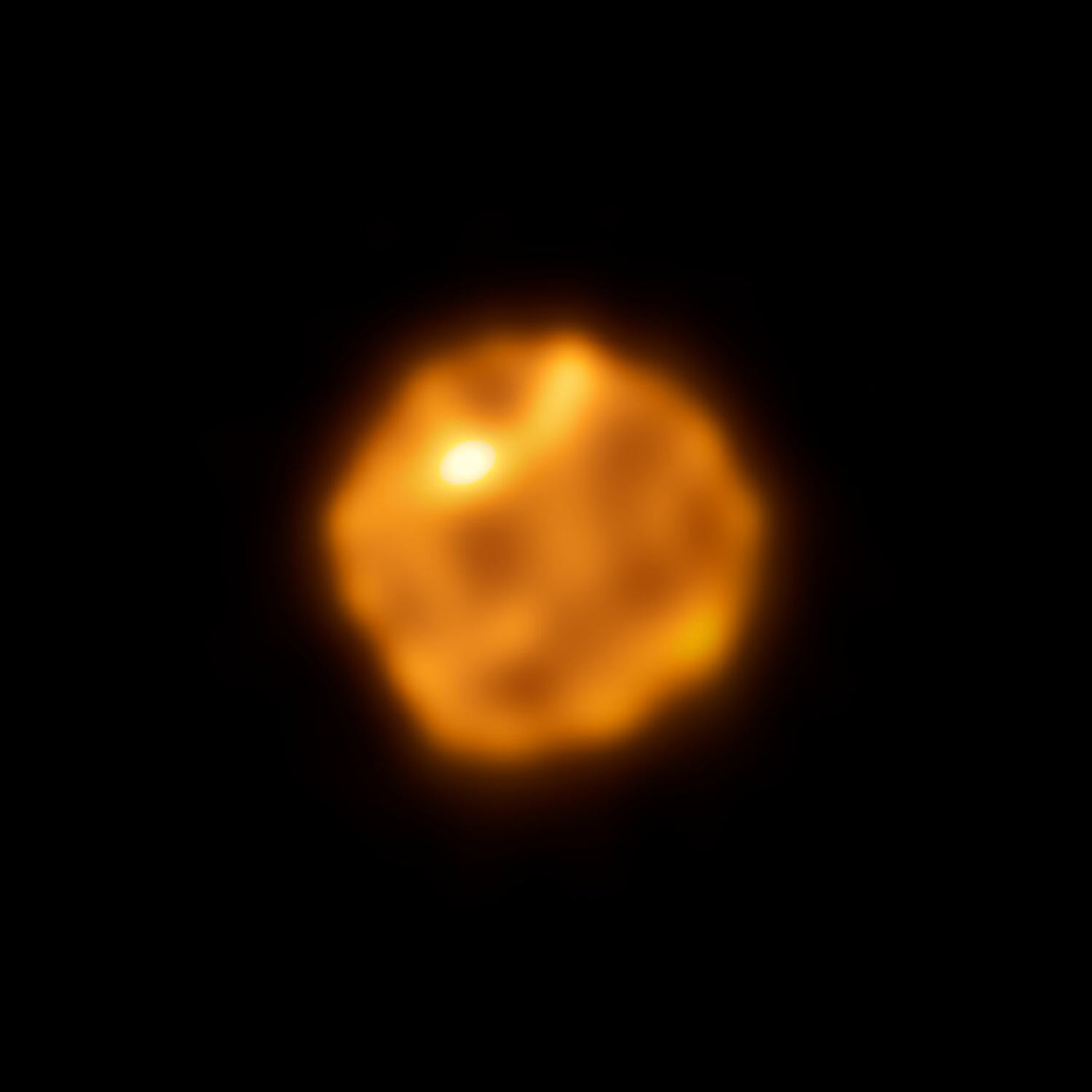
This ALMA image shows the red supergiant star Betelgeuse. Image credit: ALMA / ESO / NAOJ / NRAO / Dent et al.
Betelgeuse is an 8-million-year-old red supergiant located approximately 724 light-years away from Earth.
With a radius around 1,400 times larger than the Sun’s, Betelgeuse is one of the biggest stars known.
Also known as Alpha Orionis or Alpha Ori, it is also one of the most luminous stars known, emitting more light than 100,000 Suns.
Betelgeuse has long been suspected of harboring an uneven, blotchy surface shaped by giant convective cells (bubbles of hot gas rising from deep within the star).
“Betelgeuse (HD 39801, α Ori) is one of the two closest red supergiant stars and, as the archetype, it has been the subject of intense study from radio through to X-ray wavelengths,” said ESO astronomer Bill Dent and his colleagues.
“Its relatively large photospheric angular diameter also enables it to be resolved with current instrumentation.”
The astronomers observed Betelgeuse in August 2023 using the Atacama Large Millimeter/submillimeter Array (ALMA).
The images show that the star’s photosphere — an optically thick shell of hot gas surrounding the visible star — has an average temperature around 2,300 K, and harbors two distinctly hotter regions to the northeast and southwest.
The brightest of these regions, to the northeast, is about 800 K hotter than its surroundings.
Strikingly, the location and brightness of the northeastern hot spot closely match observations from 2015, suggesting a lifetime of at least seven years.
The researchers also found radial ‘corrugations’ of up to plus-or-minus 6% in the star’s apparent radius, concentrated in one sector of the star, though the detailed shape of this rippling has changed noticeably since 2015.
They link these features to violent convective activity: rising gas cells that drive shocks into the surrounding atmosphere, helping to seed the formation of molecules such as silicon monoxide and carbon monoxide, and eventually dust. These processes likely play a role in the star’s mass loss into interstellar space.
“Its eventual fate as a supernova makes it fascinating to know what it actually looks like now,” Dr. Dent said.
“When Betelgeuse does eventually explode, it will be bright enough to see from Earth even in broad daylight.”
The results will be published in the journal Astronomy & Astrophysics.
_____
W.R.F. Dent et al. 2026. ALMA high resolution observations of Betelgeuse: Persistent structure spanning the inner atmosphere. A&A, in press; arXiv: 2608.19339