

Paleontology

Tyrannosaurus rex Took Nearly Four Decades to Grow Up, New Research Shows

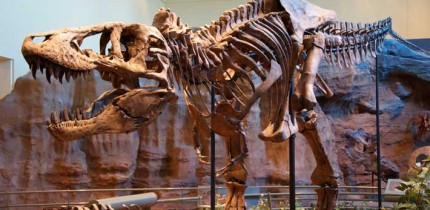
Tyrannosaurus rex holotype specimen at the Carnegie Museum of Natural History, Pittsburgh, the United States. Image credit: Scott Robert Anselmo / CC BY-SA 3.0.

A comprehensive analysis of 17 fossil specimens reveals that Tyrannosaurus rex grew far more slowly than previously thought — reaching its full-grown size of eight tons around age 40 — and challenges earlier assumptions about its life history. Tyrannosaurus rex holotype specimen at the Carnegie Museum of Natural History, Pittsburgh, the United States. Image credit: Scott Robert Anselmo...

Biology

Scientist Finds Built-In Drum in Head of Weird-Looking Fish

The rockhead poacher (Bothragonus swanii) in Oregon Coast Aquarium. Image credit: Rhinopias / CC BY-SA 4.0.

A fish species called the armored rockhead poacher (Bothragonus swanii) carries a secret that has confounded marine biologists for decades: a deep, bowl-shaped hole in the middle of its skull. This bizarre anatomical feature has now been linked to an extraordinary form of communication. The rockhead poacher (Bothragonus swanii) in Oregon Coast Aquarium. Image credit: Rhinopias / CC BY-SA 4.0. First...

Physics

New Solution to Cosmic Acceleration Challenges Dark Energy Paradigm

This artist’s impression shows the evolution of the Universe beginning with the Big Bang on the left followed by the appearance of the Cosmic Microwave Background. The formation of the first stars ends the cosmic dark ages, followed by the formation of galaxies. Image credit: M. Weiss / Harvard-Smithsonian Center for Astrophysics.

Physicists from the Center of Applied Space Technology and Microgravity at the University of Bremen and the Transylvanian University of Brașov have unveiled a new theoretical framework that could rewrite how we understand the accelerating expansion of the Universe — and potentially render the mysterious dark energy obsolete. They’ve proposed that the acceleration may be a fundamental feature...

Geology

Scientists Find Ancient Air Bubbles in 1.4 Billion-Year-Old Salt Crystals

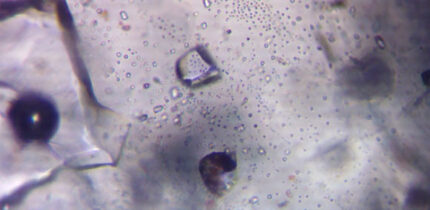
Example photographs of primary, mixed, and secondary halite inclusion assemblages. Image credit: Park et al., doi: 10.1073/pnas.2513030122.

Researchers have found ancient gases and fluids trapped in 1.4-billion-year-old halite crystals from northern Ontario, Canada. Their analyses directly constrain Mesoproterozoic (1.8 to 0.8 billion years ago) oxygen and carbon dioxide concentrations to 3.7% modern levels and 10 times preindustrial levels, respectively. The results show this was a period of equable climate and that atmospheric oxygen...